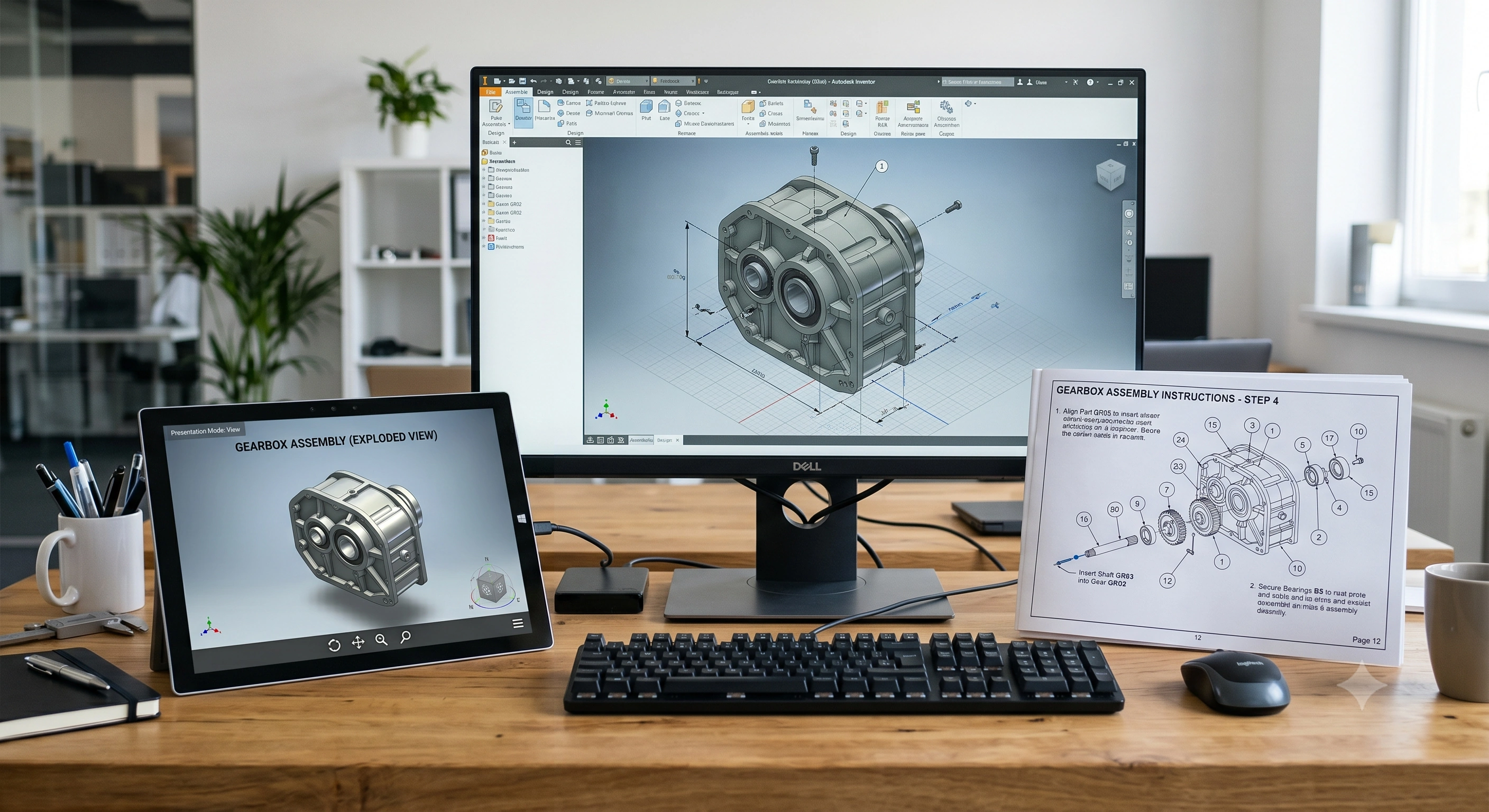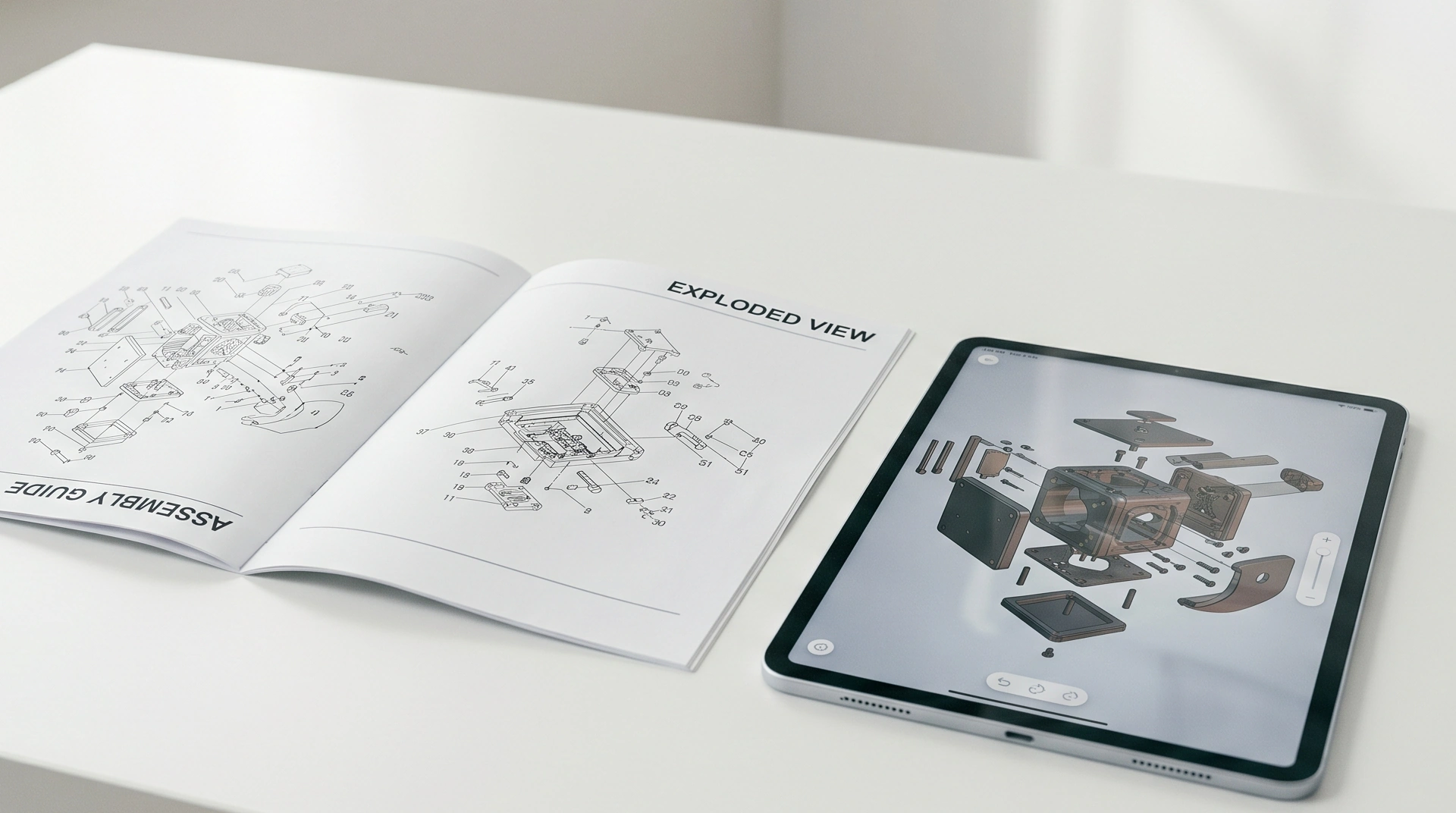
Long before interactive 3D documentation existed, exploded illustrations allowed engineers, technicians and end users to understand how assemblies fit together without reading pages of text. They remain a core feature of SOLIDWORKS Composer and similar technical publishing tools for good reason.
However, there is an important distinction between showing where parts belong and explaining how an assembly is actually built.
Most technical authors have experienced the same problem. A carefully constructed exploded view looks perfectly clear during authoring. The assembly sequence makes sense. The parts are labelled correctly. Yet support requests still arrive, manufacturing operators still ask questions and service technicians still struggle with certain procedures.
The reason is that exploded views communicate relationships between components better than they communicate intent.
When creating a Composer illustration, the author selects a camera angle that best represents the assembly. That angle becomes the user's perspective. If the information required to complete a task is not visible from that viewpoint, additional illustrations, detail views and callouts must be created.
As products become more complex, this quickly becomes difficult to maintain.
Consider a machine enclosure containing cable routing, hidden fasteners and multiple internal subassemblies. A single exploded view may communicate the overall structure, but it rarely answers every question. The author often creates enlarged details, section views and supplementary diagrams. Over time, the documentation expands because static images cannot adapt to the user's needs.
This becomes particularly noticeable during engineering changes. A bracket moves. A fastener changes length. A cable route is updated. The underlying CAD model may only require a minor modification, yet numerous documentation assets may require review.
Interactive documentation approaches the problem differently.
Instead of converting the model into a fixed set of views, the model itself becomes the documentation experience. Users can inspect assemblies from multiple angles, zoom into hidden areas and follow guided procedures while retaining access to the full 3D context.
From a technical author's perspective, this is significant because it reduces the need to anticipate every possible question. The author still defines the procedure, but the user gains the ability to investigate details independently.
This does not mean exploded views become obsolete. In fact, they remain extremely valuable. The difference is that they become part of a broader communication strategy rather than the sole mechanism for conveying assembly information.
SOLIDWORKS Composer remains excellent for generating static illustrations. Cadasio matches this and extends the usefulness of CAD-derived documentation with an interactive environment.
For organisations creating assembly instructions, the question is no longer whether exploded views are useful. The question is whether static viewpoints alone are sufficient for the products being documented today.